 Renoox
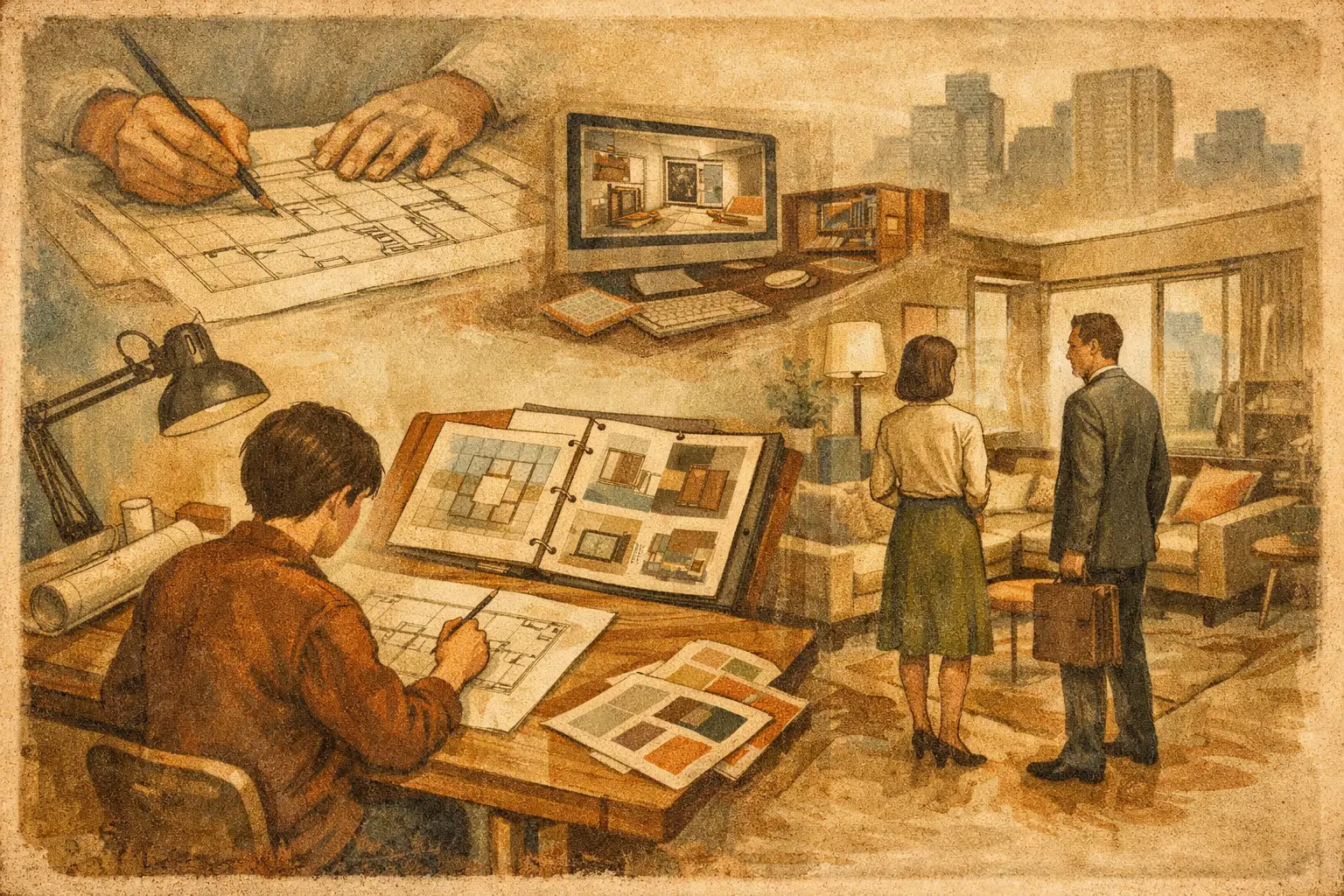
Many people who decide to move into interior design do not do so on a passing enthusiasm for renovation photos. Usually, after a few years of working, they begin to think seriously about whether their eye, their feel for space and their problem-solving ability could become a professional job. Is changing career into interior design hard? The answer is that there is a threshold, but it is not one that only people with a formal design background can cross. What really separates people is whether, in a limited time, you can build the technical ability, project experience and portfolio the industry recognises.
The difficulty is converting ability, not the starting point
Interior design is not simply choosing colours and picking furniture, and knowing a few pieces of software is not enough to do the job. A designer has to understand the client's needs and turn a vague lifestyle, business goal or brand positioning into a sound spatial layout, a material scheme, a lighting logic and drawings that can be executed.
So the hardest part of changing career is usually not your age or your lack of background. It is switching from the consumer's perspective to the professional's. You may already know which spaces feel comfortable, but a professional designer also has to explain why the circulation is planned this way, whether the dimensions are right, how the budget is controlled and whether the construction team can deliver the scheme.
That is why browsing case studies and copying renderings rarely leads to a first relevant job. The industry needs people who can take part in projects, not people who can only express preferences. The good news is that these abilities can be acquired step by step through structured training, and you do not have to wait until you feel fully ready to begin.
Before changing career, decide which professional path you are entering
Interior design has more than one career exit. Some people want to join a design firm and start as a design assistant, draughtsperson or junior designer; some want to serve residential clients and gradually build the ability to take on their own commissions; others are better suited to commercial space, soft furnishing and styling, exhibition design or adjacent roles such as design sales.
Different directions do not demand exactly the same abilities. Residential design puts more weight on daily circulation, storage, materials and client communication; commercial projects often involve brand tone, fire regulations, operational needs, and coordinating programme and cost. If your aim is to find work as soon as possible, look first at the real responsibilities of the target role rather than learning every style indiscriminately.
Working adults changing career especially need to make choices. You do not have to master every piece of software or every niche at the outset, but you must build a complete workflow: from needs analysis and plan layout to visual presentation, construction drawing notes and scheme presentation. That workflow proves professional readiness better than scattered skills.
The four foundations the industry really values
Design thinking and space planning
Good space planning is not cramming furniture into a plan; it solves problems of human behaviour. Is the entrance smooth, is the kitchen efficient to work in, do the shared areas suit conversation, are the private areas protected? Each requires a balance between the users, the conditions of the space and the limits of the budget.
A common beginner problem is chasing style too early. In reality, without a sound plan layout, even the most beautiful rendering will not survive scrutiny. Learn to analyse the floor plan, divide the functional zones and organise circulation first, and only then talk about modern, wabi-sabi or French visual languages. You will learn far more efficiently.
Technical drafting and buildability
Whether a design can be built depends on whether the drawings are clear. The furniture plan, ceiling plan, elevations, details, dimensioning and material notes are the essential language for communicating with the contractor. For a career changer, construction drawing training may be duller than producing renderings, but it is often the key to establishing professional credibility.
You do not need to become an engineering expert at the outset, but you need to know how dimensions, structure, plumbing and electrics, lighting, materials and sequence of work affect one another. Only then can you propose ideas that avoid being fit for display but not for implementation.
2D and 3D software expression
Software is a tool of expression, not the design itself. 2D planning skills let you complete plan and construction information accurately; 3D modelling and visualisation help the client understand the effect of the space. The point is not how many programs you know but whether you can complete a whole project with the right tools.
In a job application, a logically clear plan scheme with moderate 3D expression is usually more convincing than a lavish rendering that lacks dimensions and detail to back it up. Establish accuracy first, then raise the quality of presentation. That is the safer learning order.
Portfolio and project narrative
A portfolio is not a collection of images but evidence of how you solve design problems. Every project should present the background, the user needs, the concept direction, the plan iterations, the material and lighting choices and the final result. Even a course project or a hypothetical brief should be completed to the standard of a real project.
Hiring managers want to see your thinking process, not only the final picture. A portfolio that includes both residential and commercial projects shows more directly how you adapt to different scales and different client needs. For a career changer with no industry experience, the portfolio is the most important first professional calling card.
How to shorten the distance from interest to employment
Changing career efficiently is not about hoarding courses; it is about choosing a way of learning that produces results. Every module you complete should correspond to a definite ability: completing a plan scheme, drawing basic construction drawings, producing a 3D space, or presenting a project on your own. Learning that way does not stop at knowing; it becomes being able to do.
Arrange your training as continuous projects rather than fragmented exercises. Take a residential project: start with the client profile, the survey information and the list of requirements, then complete the plan layout, the stylistic scheme, the material board, the lighting plan, the 3D visuals and the drawings. Then use a commercial space project to train budget, customer flow, brand and operational thinking. Continuous projects are closer to real work and better suited to a portfolio.
The practice-based training path Renoox Academy emphasises suits people who want a clear outcome from their career change: through residential and commercial project exercises, it links design fundamentals, technical drawings, 2D planning, 3D visualisation and portfolio development into one professional workflow. The value of small-group guidance and flexible scheduling is not just convenience; it is that learners get feedback at the key points and can correct their method in time.
The detours career changers most easily take
The first detour is mistaking taste for professional ability. Taste helps you set a design direction, but it cannot replace space planning, technical expression and communication. The second is learning software without doing projects. Fluent software skills with no scheme logic still leave you struggling with the project questions in an interview.
Another is waiting too long. Some people want to wait until the portfolio is perfect, every program is mastered and there are no doubts left about the industry before applying, but design ability grows precisely through projects, feedback and collaboration. Once a basic portfolio is ready, start accumulating experience through internships, assistant roles, drafting support or small freelance projects.
Of course, a career change also needs realistic expectations. Early positions may not pay as well as your previous field, and the pace of work may follow project deadlines. If you have experience in sales, engineering, branding, customer service or project management, that background is far from useless: it can become your advantage in understanding clients, controlling process and driving projects forward.
Let the first opportunity see your preparation
When you start applying for jobs or taking commissions, do not just say that you love design. Prove your readiness with specific results: what kinds of project you have completed, how you solved the spatial problems, which tools you use, whether you can read drawings, organise material information and present a scheme clearly. Professional expression makes your decision to change career look far more credible.
Interior design takes time to mature, but the first step need not wait for some distant future. Turn your interest into abilities that can be shown, executed and evaluated, one by one, and you will find that the difficulty of changing career does not come from where you start. It comes from whether you are willing to use professional training to lay a road you can genuinely walk down.