 Renoox
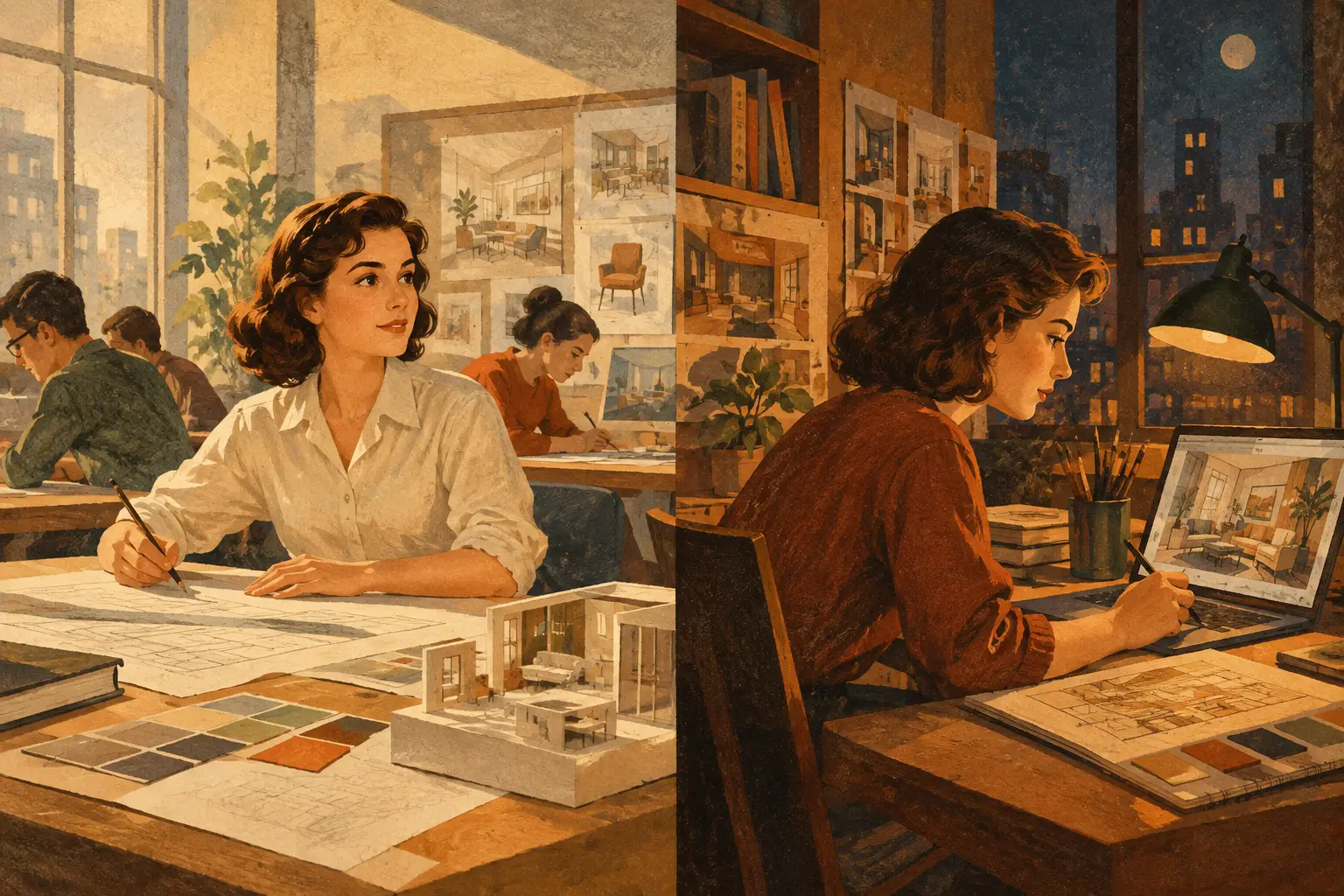
At nine in the evening, after a full day at work, you open your floor plan software; elsewhere, a full-time student is presenting a material board in class. Both want to enter the interior design industry, but the learning path that suits each of them is not necessarily the same. When comparing full-time and evening design courses, the key is not which one sounds more "professional", but which one allows you to keep up your training, build up projects and turn what you learn into a convincing portfolio.
Interior design is not a profession that relies on aesthetic judgement alone. Space planning, technical drawing, material application, lighting logic, client communication and 3D presentation all require repeated practice. Your course schedule should serve your career goals, rather than making you give up a stable rhythm of life and work just to fit around the course.
The core differences between full-time and evening design courses
Full-time courses usually put learning at the centre of your life. Within a more concentrated period, you will work through design fundamentals, residential and commercial projects, 2D planning, 3D visualisation and portfolio training. For people who want to change career as quickly as possible, recent graduates who can commit plenty of time, or anyone who needs to build design skills systematically, this high-intensity pace makes it easier to keep learning continuously.
Evening courses, on the other hand, allow working people to keep their careers and incomes stable. Classes are mostly scheduled after work or in fixed evening slots, and the overall study period may be longer, but the weekly knowledge input and project progress can more easily run alongside a real job. For those who already have work experience, want to move into design gradually, or cannot leave their current role for now, evening study is a more practical route.
The biggest difference between the two is not the course title, but how study time is allocated. Full-time courses emphasise concentrated commitment; evening courses emphasise long-term persistence. Whichever you choose, without drawing, software practice and project reviews outside class, even the best course will struggle to build professional ability.
Start with your career goal, not the class timetable
If your goal is to apply for interior design assistant, junior designer or visualisation-related roles within a relatively short time, a full-time course is usually the better fit. More intensive in-class feedback and project iteration can help you complete a well-structured portfolio faster. For learners with a weaker design foundation in particular, continuous training reduces gaps in knowledge.
But if you want to keep your current job while preparing for a future career change, an evening course does not mean lowering the bar. What it demands is clearer self-management: you need to set aside fixed drawing time in advance, complete assignments by each milestone, and keep your projects moving even when work is busy. For self-disciplined adults with clear goals, this model can make a career change more secure.
There is another situation that is easily overlooked: some learners are in no hurry to leave their jobs, but want to apply design skills within their current careers, for example in real estate, retail, home furnishings, construction management or running their own business. In this case, the gradual learning pace of an evening course may fit their real needs better than the rapid switch of a full-time programme.
When assessing a full-time course, look at project density
When choosing a full-time course, you cannot just look at the number of teaching hours. What really deserves your attention is whether you will complete projects that are close to a real working process. From analysing the client's needs to functional zoning, floor plan layout, elevations, material and furniture selection, lighting recommendations, 3D presentation and the final explanation of the scheme, every step should connect to the way the industry delivers work.
High-quality full-time training should also leave room for revision. Design ability is not formed the first time you draw a scheme; it develops when, after a tutor points out problems with circulation, proportion or presentation, you are able to rethink the scheme. This is also the value of small-group teaching: you receive not only the same lessons as everyone else, but also specific feedback on your own projects.
If the course is too theoretical, or the projects never go beyond concept images, students may lack technical work to show when job hunting, even after committing their full days to study. The advantage of full-time study should be accelerated growth, not simply more hours in the classroom.
The value of evening design courses lies in being able to see them through
The most common challenge of evening courses is not understanding design knowledge, but fatigue. Continuing to study after work requires a clear rhythm and achievable stage goals. Courses suited to working people should therefore break complex tasks down, for example completing measurement and needs analysis first, then moving on to the floor plan scheme, renderings and presentation materials, rather than concentrating a large number of tasks into the final week.
When choosing an evening course, you should also be honest about how much time you can commit outside class each week. Attending class without practising the software makes it very difficult to master 2D drafting and 3D modelling. A better arrangement is to set aside a few hours each week, in addition to class, to revise drawings, organise reference projects and refine your project presentation. The sessions do not need to be long, but they must be consistent.
Evening study has another practical advantage: you start practising real-world prioritisation earlier. The design industry often requires you to weigh up time, budget, aesthetics and client needs. The ability to move a scheme forward within limited time is itself part of professional competence.
How learners with different backgrounds should choose
Complete beginners often need more structured guidance. Colour, proportion, spatial scale and drafting conventions are not things you can master through interest alone. If you have plenty of time and want to quickly build a complete framework, from concept through to buildable presentation, a full-time course will offer a stronger sense of immersion.
People with existing experience in drawing, architecture, art or home furnishings can focus on their skill gaps. You may not need to develop visual presentation from scratch, but you may need to fill in construction drawing logic, space planning, material knowledge or professional software skills. An evening course lets you strengthen these abilities in a targeted way without interrupting your career.
For learners preparing to move into design from another industry, the selection criteria should be more pragmatic: does the course include residential and commercial projects, does it train both 2D and 3D presentation, and does it help you build a portfolio you can use in interviews? The applied project training emphasised by Renoox Academy is designed precisely to help learners move from the interest stage to being able to take part in real design work.
Portfolio progress matters more than course format
Recruiters will not judge your ability simply by whether you chose a full-time or an evening course; they care more about what you can show. An excellent interior design portfolio should present your thinking process, rather than just a few renderings. It should let people see how you understand user needs, resolve spatial constraints and organise circulation, and how you support your design decisions through drawings, materials and visual presentation.
Full-time students should avoid doing too many projects without enough depth. It is better to choose a few highly resolved, logically clear residential and commercial cases than to pile up large numbers of images that have not been properly thought through. Evening students, meanwhile, should avoid leaving projects at the sketch stage for long periods; set visible completion milestones for each project and keep turning scattered exercises into portfolio content.
When a course includes regular critiques, project revisions and portfolio development, it ends up much closer to professional training than a hobby experience, whatever time of day the classes are held.
Before you decide, ask yourself three questions
First, ask yourself: can I commit to studying consistently over the coming months, rather than being enthusiastic only at the start? Next: how quickly do I need to get into a design role, and can I temporarily cut back on work or other responsibilities? Finally: will this course give me results that employers can see, including drawings, 3D presentation, project schemes and a portfolio?
If your answer is "I need to prepare for my career change quickly and intensively", a full-time course is more likely to match your goals. If your answer is "I have to keep my job, but I am willing to keep putting in the effort", an evening course will be the more realistic choice. The path that truly suits you is not the one with the least pressure, but the one you can follow through to the end while continuing to produce results.
Your design career does not have to wait until you have the "perfect time" to begin. Once you have chosen a course that matches the rhythm of your life, treat every assignment as a page of your future portfolio, and every revision as a step closer to professional standards.